Power of Pattern Matching- Python RegEx
What is Python?
Python is a high-level, interpreted programming language known for its simplicity, readability, and versatility. Created by Guido van Rossum and first released in 1991, Python has gained widespread popularity in various domains, ranging from web development and data science to artificial intelligence and automation.
Why RegEx used in Python?
Regular Expressions (regex) are a powerful tool for pattern matching in strings. Comprising characters and metacharacters, regex allows efficient tasks like text validation and search operations. With features like character classes, quantifiers, and anchors, it provides a concise and expressive means for complex pattern matching. Mastery of regex is crucial for developers handling diverse string manipulation challenges. In Python, the ‘re’ module facilitates seamless integration and use of regular expressions.
Common use cases for RegEx in Python
Regular expressions (regex) in Python are essential for tasks like data validation, text search, and extraction. They enable parsing and tokenization in natural language processing and aid in log file analysis and web scraping. Regular expressions are versatile, finding applications in data cleaning, URL matching, and routing in web development. They are powerful tools for pattern-based substitution, config file parsing, and formal language recognition, making them invaluable for text manipulation in Python.
The Power of Pattern Matching with Python's RegEx
Regular expressions, commonly known as regex, are a robust tool in Python for pattern matching and text manipulation. The ‘re’ module provides a suite of functions to work with regular expressions, allowing developers to perform intricate operations on strings efficiently. Here’s a brief overview of the power of pattern matching using Python’s regex concepts:
Basic String Matching:
Getting started with regex involves defining a pattern to search for within a text. The findall function can extract all occurrences of a specified pattern.
Example:

Code Explanation:
- Imports the re module, which provides support for regular expressions in Python.
- Here, a sample text is defined and assigned to the variable text.
- A regex pattern is compiled using the re.compile() function. In this case, the pattern is set to look for the exact string “pattern”. The r before the string denotes a raw string, which helps in avoiding unintended escape character interpretation.
- The findall() method is used on the compiled regex pattern to find all non-overlapping occurrences of the pattern in the input text. The result is stored in the variable matches.
- The list of matches found by the findall() method. In this specific example, it will print [‘pattern’] since the word “pattern” is present in the input text.
Character Classes:
Regex allows you to define character classes, which match any one of a set of characters. For example, [aeiou] matches any vowel.
Example:

Code Explanation:
- Imports the re module, providing support for regular expressions in Python.
- A sample text is defined and assigned to the variable text.
- A regex pattern is compiled using the re.compile() function. The pattern [aeiou] is a character class that matches any single vowel (either ‘a’, ‘e’, ‘i’, ‘o’, or ‘u’). The r before the string denotes a raw string.
- The findall() method of the compiled regex pattern is used on the input text. This method finds all non-overlapping occurrences of the specified pattern in the text and returns them as a list. The result is stored in the variable vowels.
- The list of vowels found by the findall() method.
Anchor and Boundaries:
Anchors (^ and $) and word boundaries (\b) enable precise positioning within a string. This ensures that a match occurs only at the desired locations.
Example:
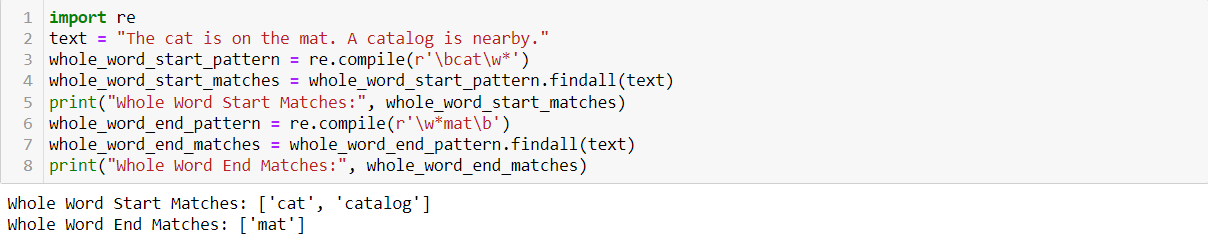
Code Explanation:
- Imports the re module, which provides support for regular expressions in Python.
- A sample text is defined and assigned to the variable text.
- A regex pattern is compiled using the re.compile() function. The pattern \bcat\w* uses the word boundary \b to match the whole word starting with “cat.” The \w* allows for matching any word characters that follow.
- The findall() method of the compiled regex pattern is used on the input text. This method finds all non-overlapping occurrences of the specified pattern in the text and returns them as a list. The result is stored in the variable whole_word_start_matches.
- Another regex pattern is compiled, this time for matching whole words ending with “mat.” The \w* allows for matching any word characters that precede, and \b ensures a word boundary at the end.
- Similar to the previous pattern, the findall() method is used to find all non-overlapping occurrences of the specified pattern in the text. The result is stored in the variable whole_word_end_matches.
Grouping and Capturing:
Parentheses are used for grouping and capturing parts of a pattern. This feature is invaluable for extracting specific information from a matched string.
Example:

Code Explanation:
- Imports the re module, which provides support for regular expressions in Python.
- text = “Product: Laptop, Price: $999.99 | Product: Smartphone, Price: $499.99”: A sample text is defined and assigned to the variable text, containing product information.
- product_pattern = re.compile(r’Product: (\w+), Price: (\$\d+\.\d{2})’): A regex pattern is compiled using the re.compile() function. The pattern Product: (\w+), Price: (\$\d+\.\d{2}) has two capturing groups:(\w+): Captures the product name (one or more word characters).(\$\d+\.\d{2}): Captures the product price in the format “$999.99” (dollar sign, digits, dot, and two decimal places).
- product_matches = product_pattern.findall(text): The findall() method of the compiled regex pattern is used to find all non-overlapping occurrences of the specified pattern in the input text. The result is stored in the variable product_matches.
- for match in product_matches:: This line starts a for loop, iterating through the captured product details in product_matches.
- product_name, product_price = match: The values captured by the regex groups in each match are unpacked into the variables product_name and product_price.
- print(f”Product: {product_name}, Price: {product_price}”): Within the loop, this line prints the formatted product details, including the product name and price.
Escape Characters and Literal Matching:
Escape characters in regular expressions, such as the backslash \, allow for literal matching of special characters. When used, they signal that the following character should be treated as a literal character rather than having its special regex meaning.
Example:

Code Explanation:
- Imports the re module, which provides support for regular expressions in Python.
- text = “The URL is https://www.example.com. Please visit.”: A sample text is defined and assigned to the variable text, containing a URL.
- url_pattern = re.compile(r’https:\/\/www\.example\.com’): A regex pattern is compiled using the re.compile() function. The pattern https:\/\/www\.example\.com uses escape characters (\/ and \.) to match the literal forward slashes and period in the URL https://www.example.com.
- urls = url_pattern.findall(text): The findall() method of the compiled regex pattern is used to find all non-overlapping occurrences of the specified URL pattern in the input text. The result is stored in the variable urls.
- print(“Matched URLs:”, urls): The script then prints the list of matched URLs found in the text.
Real World Examples and Case Studies:
Real-world applications of regular expressions (regex) span diverse fields. In healthcare, regex assists in parsing and extracting valuable information from medical records, aiding in research and patient care. In marketing, regex is employed for customer data analysis, helping businesses understand consumer behavior patterns. For software developers, regex is indispensable in code search and manipulation, facilitating efficient codebase maintenance. In e-commerce, regex supports order processing and inventory management by validating and extracting relevant details from transactional data. Additionally, regex is utilized in telecommunications for pattern matching in call records, enabling efficient analysis of communication patterns. These examples showcase how regex serves as a versatile tool, playing a critical role in solving complex challenges across different industries.
